
Non-standard dimensions or high weight do not mean that cargo cannot be transported – the key is to assess the cargo, route and infrastructure restrictions accurately before transport is booked.
From a single industrial machine to a large energy or construction module, every oversized cargo project requires an individual transport solution, permits, loading method and safe route.
What is oversized cargo?
Oversized and heavy cargo means cargo whose dimensions, weight, shape or construction prevent it from being transported in a standard container or on a conventional road vehicle without additional planning. It may be overlength, overwidth, overheight or very heavy and therefore require specialised equipment and an individually approved route.
Every project is assessed individually. Exact cargo dimensions, total weight, weight distribution, loading and unloading conditions and the route determine which vehicle is most suitable and what additional approvals are required.
How is oversized cargo transported?
The process begins with a technical assessment of the cargo. We analyse not only its dimensions and weight, but also the loading method, weight distribution, route restrictions and conditions at the final delivery location.
Based on this information, we select a suitable vehicle, plan the route and arrange permits and escort where required. Loading, cargo securing and the transport schedule are agreed before departure.
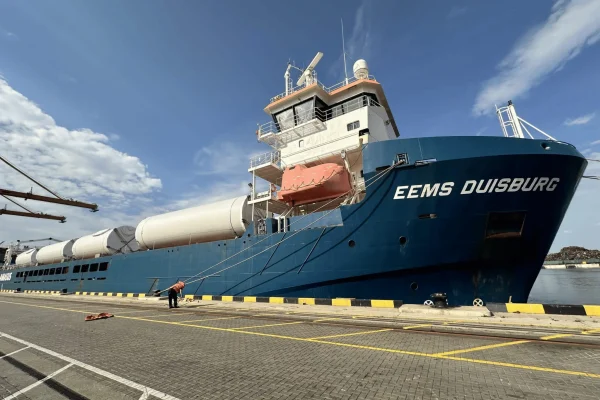
During transport, the process is coordinated according to the approved route and permit conditions. For more complex projects, road, sea, terminal and cargo-handling operations can be combined into one multimodal solution.
| Etapas | Veiksmai |
|---|---|
| 1. Cargo assessment | Dimensions, weight, shape, securing and lifting requirements are checked |
| 2. Transport selection | A low-loader, open, telescopic, modular or other suitable vehicle is selected |
| 3. Route planning | Bridges, viaducts, turns, road width, load limits and other infrastructure restrictions are assessed |
| 4. Permits and escort | Required permits, transport conditions and escort arrangements are coordinated for the route |
| 5. Loading and securing | Cargo handling, weight distribution and safe securing are organised |
| 6. Transport and delivery | The cargo is transported according to the agreed route, permit conditions and delivery schedule |
What can be shipped?
Oversized cargo solutions are used for a wide range of industrial, energy, construction and infrastructure projects. The transport method is selected for each specific cargo, so the same type of cargo may be handled differently on different routes.
Industrial machinery and machine tools
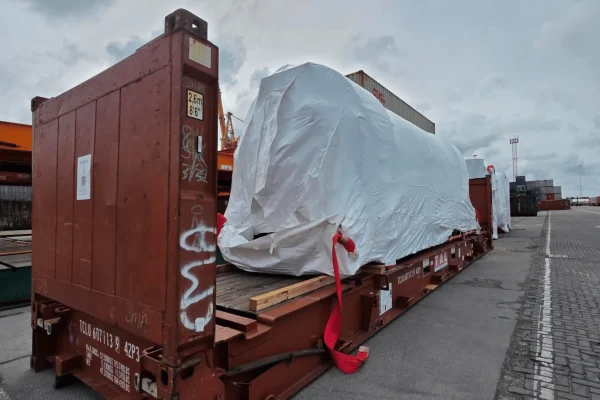
Large production machinery, presses and other industrial equipment. Depending on dimensions, low-loaders or open platforms may be used, while sea transport can involve Flat Rack solutions.
Construction and agricultural machinery
Excavators, loaders, crane components, tractors and other machinery. Low-loader platforms or other solutions that safely reduce the overall transport height are commonly selected.
Wind energy components
Tower sections, blades and other long or large-diameter elements. These cargoes may require telescopic or modular vehicles, a special route and escort.
Marine, port and energy equipment
Engines, generators, transformers, port machinery and other heavy equipment. The solution may combine road, sea and terminal operations within one project.
Steel structures and products
Long beams, pipes, tanks, structural components and other non-standard-size products. Transport is selected according to length, width, height, weight and securing possibilities.
Modular and project cargo
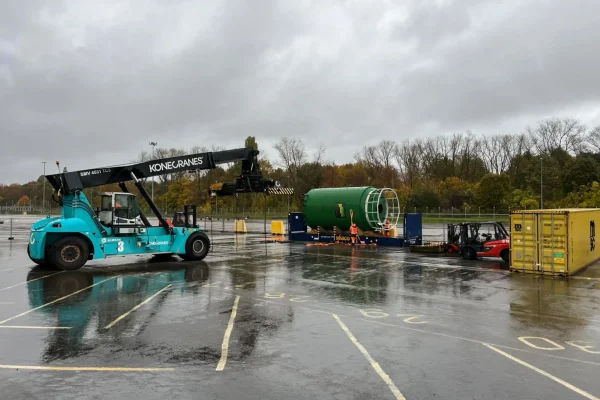
Large modules, process lines, reactors and other individually engineered project cargo. In such cases, a dedicated multimodal transport plan is prepared from loading to final delivery.
What should you consider?
Accurate data is fundamental in oversized cargo logistics. Provide the final packed dimensions – length, width and height – and total weight. Where relevant, the centre of gravity, support points and lifting points are also important. Even a small difference in dimensions can change the required vehicle, route or permits.
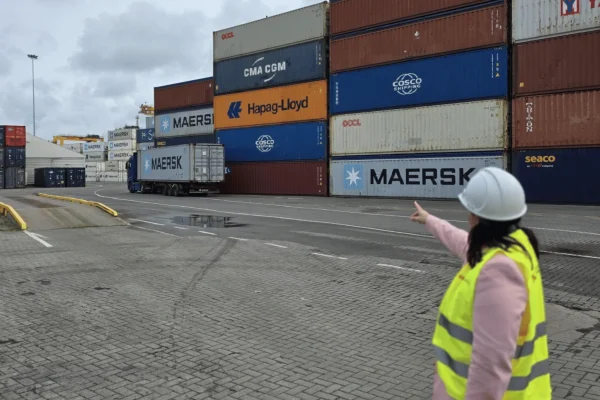
A route is assessed on more than distance alone. We check road width and turns, bridge and viaduct clearances and load limits, power lines, road works, and access to terminals and loading locations. A preliminary route survey may be carried out for more complex projects.
The need for special permits and escort depends on cargo dimensions, weight, route and the requirements of each transit country. Permit coordination therefore starts before the transport date is finally confirmed. Private or authority-required escort is arranged where necessary.
Before the vehicle arrives, it must be clear how the cargo will be loaded and unloaded, what lifting equipment is required and where the safe securing points are located. Correct weight distribution, supports and cargo securing are essential for safe transport.
Oversized cargo permits may specify particular driving hours and restrictions for weekends or peak traffic periods. Conditions vary by country and route, so it is advisable to allow extra time in the delivery schedule and coordinate timing together with the permit process.