
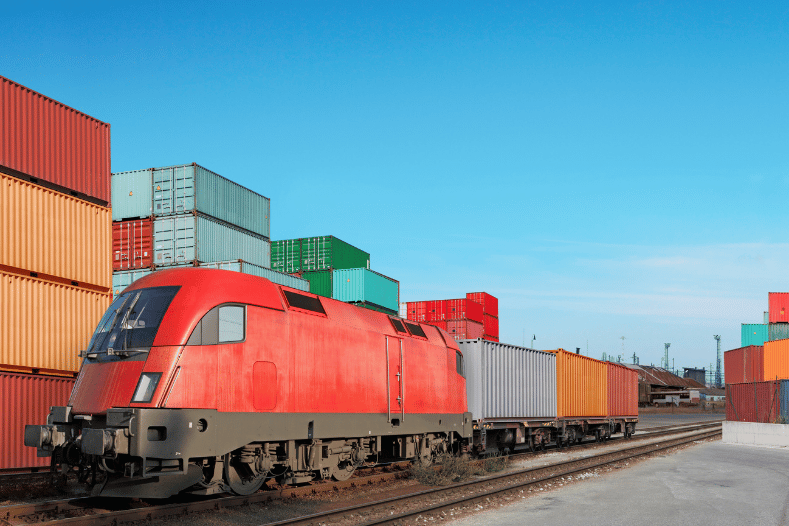
Container transport from China to Lithuania is most commonly organised by sea or rail. When choosing between train and vessel, the two main factors are delivery time and transport cost.
Rail is generally faster but more expensive. Sea freight takes longer but is usually more economical, especially for full containers and larger cargo volumes.
Below is a practical comparison for the Shenzhen, China–Klaipėda route based on price and transit data available to us in July 2025. Actual rates and transit times change constantly, so they should always be checked again for a specific shipment.
Container shipping from China: rail or sea?
Both modes can be suitable, but their advantages differ. Rail is generally chosen when shorter delivery time is important, while sea freight is preferred when lower cost is the priority.
Transit time
Container transport by rail can typically take around 15–25 days depending on the specific route, terminals and transshipments.
The same cargo by sea may take around 55–60 days, including the main sea voyage and some terminal operations. For cargo with a critical delivery deadline, the rail alternative is therefore often worth evaluating.
Reliability and route planning
Reliability of rail and sea transport depends on the particular route and market conditions. Rail is affected by border terminals, transshipments and network capacity, while sea transport is affected by port congestion, shipping-schedule changes and geopolitical conditions.
When planning container transport from China, it is therefore important to assess not only theoretical transit time but also the routes that are actually operating at the time and their stability.
More information about Europe’s rail transport and cross-border freight system is available on the European Commission transport website.
Price
Although rail is faster, price often becomes the main factor when choosing a transport mode.
Based on the data available to us in July 2025, transport of a full 40′ HC container from Shenzhen to Klaipėda cost about USD 3,500 by sea and about USD 8,000 by rail.
In this specific comparison, rail transport was therefore approximately 2.3 times more expensive than sea freight.
Cargo volume and specifics
For larger cargo volumes, sea freight is generally the more economical option because the cost of transporting the container is spread across a larger quantity of cargo.
Rail can be attractive when the cargo needs to arrive faster but air freight would be too expensive, or when a shorter transit time is more important to the business than the lowest transport cost.
Before choosing a mode of transport, it is also worth assessing the cargo weight, dimensions, dangerous-goods classification, temperature requirements and final delivery terms.
When should you choose rail and when sea freight?
- Rail is worth considering when shorter transit time is important and a higher transport cost is acceptable.
- Sea freight is generally the better choice when lower cost is the main priority and a longer transit time does not create problems for the business.
- In both cases, the final decision should be based on the price, deadline and routes available for the specific cargo at that time.
Summary of container shipping from China
There is no single transport mode that is best in every case for container shipping from China. Rail can significantly shorten transit time, while sea freight generally reduces transport costs.
Before booking a shipment, it is therefore worth comparing not only the base freight rate but the entire route, delivery deadline and additional costs associated with each mode.
If you need to compare a specific route from China to Lithuania, the TLC team can assess the sea and rail alternatives currently available.