
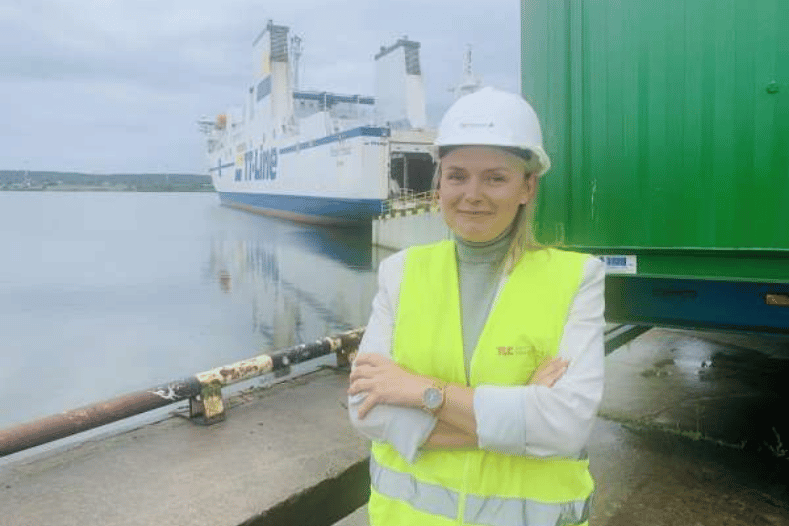
The work of a freight forwarder often remains invisible, even though freight forwarders are the people who help ensure that cargo moves smoothly from shipper to consignee. To give a better insight into the day-to-day reality of the profession, we spoke with Raimonda Tupikaitė, Freight Forwarding Manager at UAB Tarptautinės logistikos centras, who has worked in logistics for ten years.
How did the journey into logistics begin?
How did you decide to become a freight forwarding manager and how did your career begin?
I entered the logistics sector thanks to someone close to me. He worked at a port company and inspired me to try an area that was unfamiliar but intriguing.
My introduction to logistics began with an internship because I came from a completely different sector – sales. During the internship I realised just how broad and interesting logistics is, so I decided to complete studies in Transport and Logistics Engineering.
After graduating, my professional journey in logistics began. I tried working as a customs broker, ship agent and rail freight coordinator. However, the freight forwarding manager role suited me best, so I chose to continue developing in this field.
What does a freight forwarder do every day?
What are your main responsibilities and day-to-day tasks?
My responsibilities are very varied. Every day I plan and coordinate the transport of clients’ cargo from point A to point B and communicate with everyone involved in the logistics chain – clients, cargo-terminal specialists, representatives of authorities and other partners.
My work includes receiving orders, completing documents, providing updates on cargo movement, concluding agreements and negotiating prices. I also take care of transport documentation, customs procedures, insurance documents and other required permits.
What is a freight forwarder?
How would you briefly describe the freight forwarding profession?
A freight forwarder is a specialist who organises the transportation of clients’ cargo and helps manage import and export processes. They advise the client, plan the movement of the cargo, assess transport options and help arrange the required documentation.
The role requires specialised knowledge of transport requirements, regulations, documents and costs. This makes the freight forwarder an important link in helping the client organise the entire cargo journey more efficiently. More information about freight forwarding functions is available from the International Federation of Freight Forwarders Associations (FIATA) informacijoje.
What skills does a freight forwarder need?
What qualities are most important for success as a freight forwarding manager?
A freight forwarder must be able to coordinate many different tasks – from planning the optimal route to handling documentation – and ensure the entire process runs smoothly and efficiently.
I would highlight organisational skills, strong communication, technical knowledge and a good understanding of the specifics of the logistics and transport sector. This combination of skills helps ensure the smooth movement of goods throughout the logistics chain.
The biggest challenge – constantly changing circumstances
What challenges do you face in your work?
The biggest challenge in our work is unexpectedly changing circumstances. These can include transport delays, disruptions at ports, customs-system outages or weather conditions that cannot be controlled.
In such situations, you need to react quickly and look for alternative solutions so that the cargo reaches its destination with as little delay as possible.
International freight transport also requires extensive knowledge of documents and legislation. Different countries have different requirements, so it is essential to keep track of changes and ensure that documents are prepared correctly and on time.
The most memorable project – four shades of pink
What has been your greatest professional success or most memorable moment?
Meeting a client’s expectations is already a professional success. But one project stands out most, when I had to take care of a distinctive fertiliser shipment delivered to the Port of Klaipėda.
At first the task seemed simple, but it turned out that the fertiliser was pink and came in four different shades. The cargo had to be sorted precisely by colour, even though every person perceives shades slightly differently.
It took a great deal of patience, attention and teamwork before the cargo was sorted correctly. The situation was a perfect reminder that freight forwarding sometimes involves solving completely non-standard tasks in order to meet the client’s expectations.
Professional knowledge must be continuously updated
Does this profession require continuous professional development?
Yes, it is very important. You need to continuously follow developments in transport and logistics. This helps you notice changes faster, generate new ideas and offer clients more suitable solutions.
Working in this sector means constantly improving and being able to adapt to a changing environment, because that is the only way to ensure high-quality service for the client.
Work-life balance
How do you maintain balance in such a dynamic profession?
Good time planning, a clear separation between work and personal time, self-care and support from loved ones all help. Although this takes effort, these things make sure professional life does not overshadow personal life.
Still, I have to admit that I often answer phone calls regardless of the time of day – I feel responsible for meeting our clients’ expectations.
Freight forwarding is more than transporting cargo
Raimonda’s experience shows that freight forwarding involves much more than coordinating a cargo route or documents. It is a profession in which knowledge, communication, rapid response and the ability to find a solution even when the situation takes an unexpected turn all need to come together every day.